


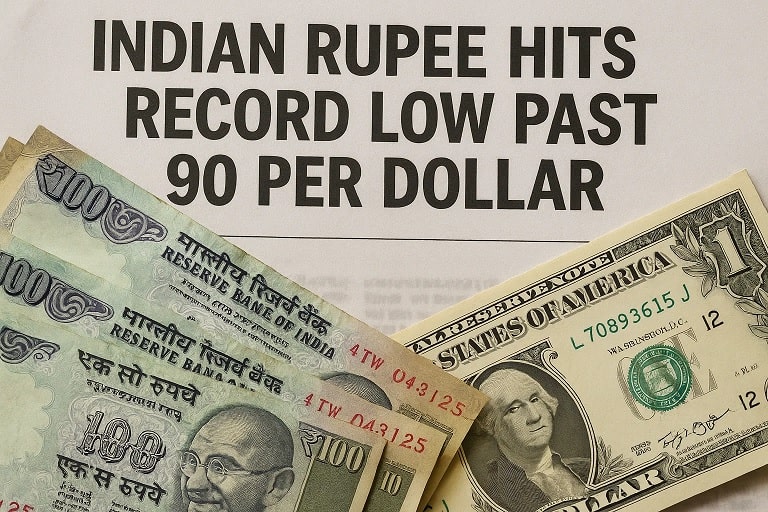
Indian Rupee Hits Record Low Past 90 Per Dollar: Trade Stalemate and Outflows Trigger Currency Meltdown
On December 3, 2025, the Indian rupee plummeted to a historic nadir, breaching the psychologically pivotal 90 per US dollar mark for the first time ever, as relentless foreign investor outflows and a protracted US-India trade impasse battered Asia’s weakest performer. The currency sank as low as 90.14 against the greenback in early trading, eclipsing its prior all-time low of 89.9475 from the previous day, before settling marginally higher at around 90.06 by mid-morning. This marks the third consecutive record low in under a week, amplifying fears of imported inflation and economic headwinds in a nation already grappling with slowing GDP growth at 6.8% for FY26 projections. With the Reserve Bank of India (RBI) adopting a hands-off stance amid depleted forex reserves dipping below $650 billion, the rupee’s freefall underscores vulnerabilities in India’s $3.9 trillion economy, drawing sharp criticism from markets and social media alike.
The Anatomy of the Fall: What Drove the Rupee Past 90
The rupee’s dramatic slide isn’t isolated—it’s the culmination of layered pressures converging in late 2025. Foreign portfolio investors (FPIs) have yanked out over $15 billion from Indian equities and debt since October, fleeing to US Treasuries yielding 4.5% post-Fed rate cuts, while a stalled bilateral trade pact with Washington exacerbates import costs for oil and electronics, which devour 70% of India’s $800 billion import bill.
Key Triggers Behind the Record Depreciation
- US-India Trade Limbo: Negotiations for a mini-trade deal, aimed at slashing tariffs on $500 billion in bilateral goods, remain in deadlock over agricultural subsidies and digital taxes, stoking uncertainty and capital flight.
- Global Dollar Strength: The USD index hovered near 108, bolstered by safe-haven flows amid Middle East tensions and China’s economic slowdown spilling into Asian currencies.
- Domestic Inflation Pressures: Core CPI at 5.2%—fueled by monsoon deficits and subsidy cuts—erodes RBI’s intervention appetite, leaving the rupee exposed to speculative shorts.
Traders on X (formerly Twitter) captured the frenzy, with one user quipping, “INR slipping again USD at ₹90+ now. Trend clearly upward this month,” while another lamented, “1 USD is now equivalent to 90 INR… Government should push it towards 100 to make calculation easy.” Sarcasm aside, the breach has ignited debates on economic mismanagement, with posts decrying it as “the worst performing currency in Asia” amid political distractions.
A Timeline of the Rupee’s Relentless Decline: From 80 to 90 in 18 Months
The rupee’s journey from relative stability to sub-90 fragility traces a volatile arc, accelerated by post-pandemic recovery pains and geopolitical shocks. Here’s a snapshot:
| Date/Month | Exchange Rate (INR/USD) | Key Catalyst |
|---|---|---|
| June 2024 | 83.50 | RBI interventions cap slide amid election volatility. |
| October 2024 | 84.20 | FPI inflows reverse on strong Q2 GDP (7.2%). |
| March 2025 | 85.75 | Oil spikes to $90/barrel strain import bill. |
| July 2025 | 87.45 | US Fed pause triggers dollar rally; rupee tests 88. |
| November 2025 | 89.95 | Trade talks stall; FPI exit $10B in equities. |
| Dec 2, 2025 | 89.9475 | Record low as outflows hit $5B weekly. |
| Dec 3, 2025 | 90.14 | Historic breach; settles at 90.06 amid thin intervention. |
This 8% depreciation year-to-date outpaces peers like the Thai baht (down 4%) and Indonesian rupiah (down 5%), positioning INR as Asia’s laggard.
Inside the Market Mayhem: Trader and Analyst Reactions
Mumbai’s forex desks buzzed with urgency as the rupee pierced 90, with interbank volumes spiking 25% in the first hour. “The lack of forceful RBI action is baffling,” noted a Bloomberg analyst, pointing to reserves at a three-month low. On X, sentiments ranged from fatalistic—”90% of the people crying about the USD don’t even have enough INR to begin with”—to alarmist: “Imports get costlier. Inflation gets tougher. And the common man pays the price.”
Latest Developments: December 2025’s Forex Frenzy Unfolds
The breach unfolded amid a whirlwind week: On November 28, FPIs dumped $2.5 billion in bonds, followed by equity outflows accelerating to $3 billion by December 2. RBI Governor Shaktikanta Das hinted at “calibrated measures” in a November 30 speech, but spot interventions remained absent, with only verbal jawboning to stem panic.
Social Media Storm: Memes, Mockery, and Market Warnings
X erupted with over 5,000 posts on #USDINR by midday, blending humor—”Ab ki baar 90 paar 🤣”—with policy jabs: “USD adjusted NIFTY50 returns are negative… You are not only losing your wealth to inflation but also depreciation.” Viral threads dissected historical parallels, like the 2013 taper tantrum when INR hit 68.75, warning of a repeat without swift reforms.
Related News: Global Echoes and Asian Currency Woes
The rupee’s rout resonates regionally:
- Asian Peers in Peril: The Indonesian rupiah weakened 1.2% to 16,200 per USD, while the Philippine peso hit 59—both trailing INR’s plunge but signaling broader EM stress.
- US-India Trade Tango: G7 allies mull 50-100% tariffs on Chinese and Indian goods, per leaked docs, further clouding a $190 billion export lifeline.
- Oil Overlay: Brent crude at $82/barrel adds $20 billion to India’s annual import tab, per IMF estimates.
- Fed’s Shadow: December FOMC minutes, due December 4, could prolong dollar dominance if cuts stay shallow.
In tandem, Sensex futures dipped 0.8%, with IT heavyweights like Infosys—buoyed by a recent buyback—still down 2% YTD in USD terms.
RBI’s Tightrope: Intervention or Inaction?
Critics slam the central bank’s $20 billion reserve burn since July as insufficient; whispers of a 50bps repo rate hike swirl, though inflation risks loom.
Future Outlook: Can the Rupee Rebound by 2026?
Analysts forecast a grim near-term: Bloomberg pegs 91.50 by March 2026 absent trade breakthroughs, but a Q1 deal could stabilize at 88. Upsides include RBI’s $50 billion forex swaps and potential PLI scheme extensions to boost exports 15%.
Recovery Roadmaps
- Trade Thaw: A US mini-deal by February could unlock $10 billion in inflows.
- Domestic Reforms: GST 2.0 and farm subsidy tweaks to curb deficits.
- Global Tailwinds: Fed easing to 3.75% by mid-2026 might cap USD at 105.
Pessimists eye 95 if oil hits $100, but optimists bet on India’s 7% growth narrative drawing $100 billion FDI.
Broader Impacts: From Wallets to World Stage
The 90-cross casts long shadows:
Household Hit: Inflation’s Hidden Tax
Fuel and edible oils, 40% of CPI basket, could surge 5-7%, eroding real wages for 500 million middle-class families. “The common man pays the price every time,” echoed X users.
Corporate Crunch: Exporters vs. Importers
IT and pharma gain 8% competitiveness, but oil refiners like Reliance face $15 billion hits; Nifty IT up 1% intraday on rupee woes.
Geopolitical Gambit
Erodes India’s EM clout, pressuring BRICS rupee trade pushes amid USD weaponization fears.
Social Sentiment: From Sarcasm to Strategy
X threads blend mockery—”Do kaudi ke andhbhakto ka is se koi lena dena nahi hain”—with calls for fiscal prudence, amplifying public angst.
Asian Currencies: INR’s Record Low in Context Table
| Currency | vs. USD (Dec 3, 2025) | YTD Change (%) | Key Pressure |
|---|---|---|---|
| Indian Rupee (INR) | 90.06 | -8.2 | Trade limbo, FPI outflows |
| Indonesian Rupiah (IDR) | 16,200 | -5.1 | Commodity slump |
| Thai Baht (THB) | 36.45 | -4.3 | Tourism slowdown |
| Philippine Peso (PHP) | 59.10 | -3.8 | Remittance dips |
| South Korean Won (KRW) | 1,380 | -6.5 | Export woes |
INR’s dive outstrips regional peers, per Nikkei data.
Frequently Asked Questions (FAQs) on Rupee’s Record Low
Why Did the Rupee Fall Past 90 Today?
Persistent FPI outflows ($15B since Oct) and US-India trade stalemate, sans RBI firepower, propelled the breach.
Will RBI Intervene to Stem the Slide?
Likely verbal cues first; spot sales if it nears 91, but reserves constrain aggressive moves.
How Does This Affect Everyday Indians?
Higher fuel (up 3-5%) and imports inflate costs; savers lose 8% purchasing power YTD.
Is This Worse Than Past Crises?
Deeper than 2013’s 68.75 low in percentage terms, but forex buffers (20 months imports) offer resilience.
Can Trade Talks Save the Rupee?
A February deal could rally it to 88; delays risk 92 by Q1 2026.
What’s the Long-Term Outlook?
Stabilization at 88-90 with reforms; 7% growth narrative to lure $120B FDI by 2027.