


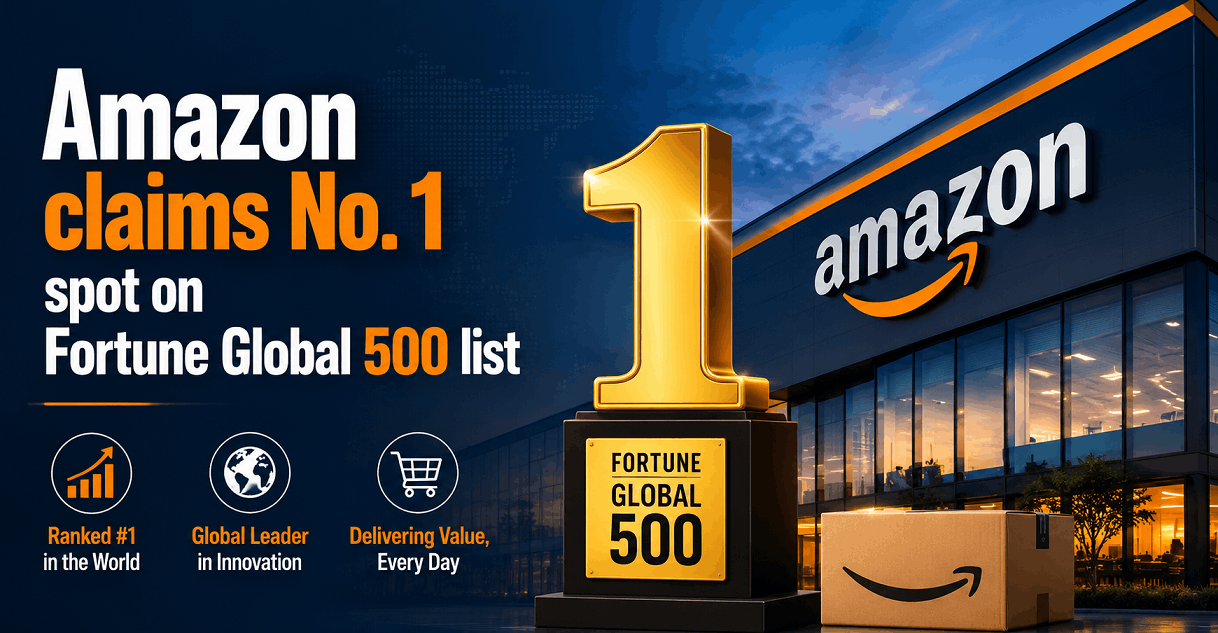
Amazon Claims No. 1 Spot on Fortune Global 500 List: Ending Walmart’s Long Reign
Amazon has officially claimed the top position on the 2026 Fortune Global 500 list, becoming the world’s largest company by revenue and ending Walmart’s 12-year streak at No. 1. With a 12% revenue jump in 2025 that pushed the company past the $700 billion mark, Amazon has solidified its status as a global business powerhouse spanning e-commerce, cloud computing, advertising, and artificial intelligence.
This historic shift highlights the growing dominance of technology-driven firms and the evolving landscape of global corporate power.
How Amazon Secured the Top Spot
Amazon’s rise to No. 1 was fueled by strong performance across its diversified businesses. North American and international retail operations continued to grow, while Amazon Web Services (AWS) delivered accelerated expansion, contributing significantly to overall revenue. Advertising and subscription services further bolstered the numbers.
The company reported approximately $717 billion in revenue for the 2025 fiscal year, narrowly surpassing Walmart. This achievement marks a dramatic climb from Amazon’s debut on the Fortune 500 at No. 492 more than two decades ago.
A $200 Billion AI Bet
Amazon expects to spend roughly $200 billion in capital expenditures in 2026, with the vast majority directed toward AI infrastructure including data centers, chips, and networking hardware. The figure represents a nearly 60 percent increase from the approximately $132 billion spent in 2025. Jassy first disclosed the target during Amazon’s Q4 2025 earnings call in February, saying the company “will not be conservative in this AI cycle.”
From Online Bookstore to Global Leader
Amazon’s path to the top is one of the most remarkable stories in business history. Founded in 1994 as an online bookstore, the company expanded into a vast e-commerce marketplace, then pioneered cloud computing with AWS, and later entered advertising, streaming, and advanced logistics.
Only four companies have ever held the No. 1 position on the Fortune 500 or Global 500 in recent decades: General Motors, ExxonMobil, Walmart, and now Amazon. Walmart’s long dominance reflected the power of traditional retail scale, while Amazon’s ascent demonstrates the advantages of technology platforms and diversified revenue streams.
Top Companies on the 2026 Fortune Global 500
The latest ranking places several major corporations near the top:
| Rank | Company | Country |
|---|---|---|
| 1 | Amazon.com | United States |
| 2 | Walmart | United States |
| 3 | State Grid | China |
| 4 | UnitedHealth Group | United States |
| 5 | Saudi Aramco | Saudi Arabia |
| 6 | Apple | United States |
| 7 | McKesson | United States |
| 8 | Alphabet | United States |
| 9 | CVS Health | United States |
| 10 | China National Petroleum | China |
Latest Developments and Market Reaction
The announcement of the 2026 Fortune Global 500 list has drawn widespread attention, with Amazon’s achievement celebrated as a milestone in corporate history. Jeff Bezos and current CEO Andy Jassy have been highlighted for guiding the company through continuous reinvention, including major investments in AI infrastructure and cloud capacity.
Markets have largely viewed the ranking as validation of Amazon’s long-term strategy, even as the company balances aggressive expansion with operational efficiency measures.
Impacts on Competitors, Employees, and the Global Economy
Amazon’s new ranking intensifies competition in retail, cloud services, and digital advertising. Rivals such as Walmart, Microsoft, Google, and Alibaba face heightened pressure to innovate and expand.
For employees and partners, the achievement underscores Amazon’s scale and influence, employing hundreds of thousands worldwide and supporting vast supplier networks. Economically, the ranking highlights the concentration of corporate power among a few tech giants and raises ongoing discussions about market concentration, labor practices, and regulatory scrutiny.
Future Scope and Strategic Outlook
Looking ahead, Amazon is expected to deepen its investments in artificial intelligence, robotics, and logistics automation. AWS remains a key growth engine, particularly as demand for AI computing capacity surges. Expansion into new markets, healthcare, and advanced advertising could further widen the company’s lead.
Challenges include intensifying competition, potential regulatory actions, and the need to maintain customer trust while scaling operations. Success will depend on continued innovation and disciplined execution under current leadership.
Broader Trends in the Fortune Global 500
The 2026 list shows continued strength among technology and healthcare companies. The so-called “Magnificent Seven” tech firms generated substantial collective revenue and profits. U.S. representation remains high, while Chinese state-owned enterprises maintain strong positions in energy and utilities. Women CEOs also reached a record number on the Global 500, reflecting gradual progress in leadership diversity.
Frequently Asked Questions
Why did Amazon overtake Walmart on the Fortune Global 500? Strong revenue growth across e-commerce, AWS, and advertising allowed Amazon to surpass Walmart’s total sales for the first time in the ranking.
How much revenue did Amazon report? Amazon exceeded $700 billion in 2025 revenue, with reports citing approximately $717 billion.
What is the difference between the Fortune 500 and Fortune Global 500? The Fortune 500 ranks the largest U.S. companies, while the Global 500 includes companies worldwide by revenue.
Has any other tech company held the top spot before? No. Amazon is the first technology-focused company to claim the No. 1 position in the modern era of the ranking.
What does this mean for Amazon’s future? It reinforces Amazon’s position as a diversified platform company and strengthens its ability to invest in long-term growth areas such as AI and cloud computing.
Will Walmart challenge for the top again? Walmart remains a formidable competitor with massive scale in physical and digital retail, so future ranking shifts remain possible depending on relative growth rates.
Amazon’s New Era of Leadership
Claiming the No. 1 spot on the Fortune Global 500 represents both a culmination of decades of ambitious expansion and a starting point for the next phase of growth. As Amazon continues to evolve beyond traditional retail into advanced technology and infrastructure, its influence on global commerce, innovation, and everyday life is set to expand further. The ranking serves as a clear marker of how technology platforms have reshaped the hierarchy of the world’s largest companies.