


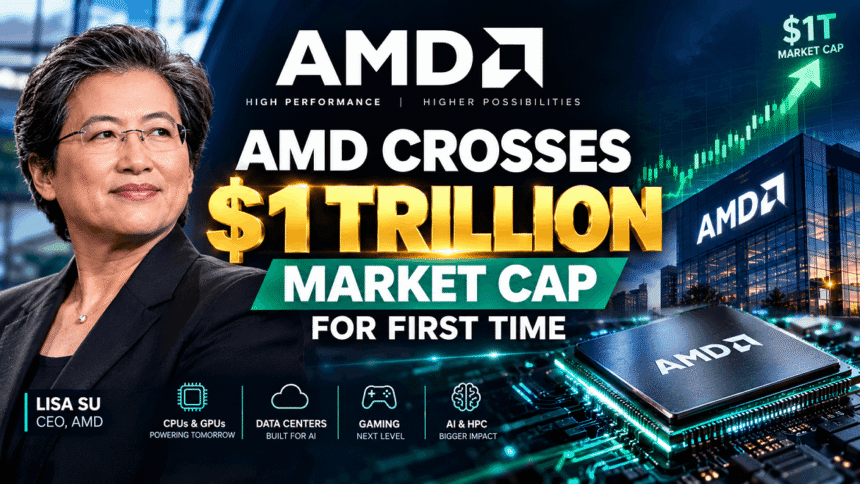
AMD Crosses $1 Trillion Market Cap for First Time
Advanced Micro Devices (AMD) has crossed the $1 trillion market capitalization threshold for the first time, joining an exclusive group of technology and semiconductor companies. The milestone was reached as the stock surged to record highs amid strong investor enthusiasm for artificial intelligence chips and data center growth.
This achievement marks a dramatic transformation for a company that was once struggling and underscores the power of the AI-driven semiconductor boom.
How AMD Reached the $1 Trillion Milestone
AMD shares climbed sharply in a multi-day rally, with gains of around 9–10% on the key session pushing the stock to an intraday high above $610–$616. Based on shares outstanding, this lifted the company’s market value above $1 trillion. The stock has gained more than 180% year-to-date and roughly 24% over a five-session stretch leading into the milestone.
The broader semiconductor sector also advanced, with peers such as Intel and others posting strong gains as AI-related optimism spread across the industry.
Drivers Behind the Rally
Demand for AI accelerators and data center processors has been the primary catalyst. AMD’s data center segment has delivered exceptional growth, with recent quarterly results showing data center revenue more than doubling year-over-year in some periods and overall company revenue rising significantly.
Key products including EPYC server CPUs and Instinct AI accelerators have gained traction with hyperscalers and enterprise customers. High-profile commitments, including deployments involving major AI companies, have reinforced confidence in AMD’s growth trajectory. Management has guided for continued strong expansion in data center revenue in coming years.
AMD Joins the Elite Semiconductor Trillion-Dollar Club
AMD becomes the fourth U.S. semiconductor company to reach a $1 trillion valuation, following Nvidia, Broadcom, and Micron. Nvidia remains far ahead with a market capitalization several times larger, reflecting its dominant position in AI GPUs.
The milestone also places AMD well ahead of longtime rival Intel in market value, reversing a historical gap that once saw Intel valued many times higher than AMD.
Historical Journey: From Turnaround to Trillion-Dollar Company
When Lisa Su became CEO in 2014, AMD was valued at roughly $2 billion and faced significant challenges. Through a focus on high-performance computing, improved product roadmaps, and strategic execution in CPUs and GPUs, the company rebuilt its competitive position.
The AI boom accelerated this progress. AMD’s ability to capture share in servers and expand its AI accelerator offerings has driven the valuation surge that culminated in the $1 trillion milestone.
Market Context and Sector Impact
The broader chip sector has benefited from surging demand for memory, accelerators, and related infrastructure tied to AI training and inference. AMD’s milestone reflects both company-specific execution and the overall re-rating of semiconductor firms exposed to AI workloads.
Investors are paying premium valuations for growth, with AMD trading at elevated multiples relative to some peers, reflecting expectations of continued share gains and revenue expansion.
Key Financial and Market Highlights
| Metric | Details |
|---|---|
| Market Cap Milestone | First time above $1 trillion |
| Recent Stock Performance | ~9–10% single-day gain; >180% YTD |
| Data Center Growth | Strong double-digit to triple-digit gains in recent quarters |
| Position Among Chipmakers | 4th U.S. semiconductor firm at $1T+ |
| Comparison to Nvidia | Still significantly smaller market cap |
| Comparison to Intel | Now valued higher than longtime rival |
Future Scope and Challenges
Looking ahead, AMD’s ability to sustain growth depends on continued adoption of its Instinct accelerators, further gains in the server CPU market, successful execution of product roadmaps, and maintaining competitive positioning against Nvidia and others. Guidance pointing to further data center expansion provides a foundation for optimism.
Challenges include intense competition, high valuation expectations, supply chain dynamics, and the need to convert design wins into sustained revenue and profitability growth. Any slowdown in AI infrastructure spending could pressure the stock.
Impacts on Investors and the Industry
The $1 trillion valuation elevates AMD’s profile among institutional investors and index funds. It also intensifies the competitive narrative in semiconductors, highlighting the bifurcation between AI beneficiaries and companies with less exposure. For the broader industry, it reinforces the scale of capital being allocated to AI hardware providers.
Frequently Asked Questions
When did AMD first cross $1 trillion in market cap?
AMD reached the milestone in September 2026 during a strong multi-day rally driven by AI and data center optimism.
What drove AMD’s stock higher?
Strong growth in its data center business, demand for AI accelerators and EPYC processors, and broader enthusiasm for semiconductor stocks tied to artificial intelligence.
How does AMD compare to Nvidia?
Nvidia remains the clear leader with a much larger market capitalization and dominant share in AI GPUs. AMD is a significant but smaller competitor gaining traction.
Is AMD now more valuable than Intel?
Yes, AMD’s market capitalization has surpassed that of Intel.
What are the risks at this valuation?
High expectations for continued AI-driven growth, competition, and potential shifts in capital spending by hyperscalers.
What is the outlook for AMD’s data center business?
Management has indicated expectations for further strong growth, including potential doubling of data center revenue in subsequent years based on current guidance and customer commitments.
A Landmark Moment in Semiconductor History
AMD’s crossing of the $1 trillion market capitalization threshold represents a defining achievement in the company’s modern history. From a struggling chipmaker a decade ago to a major player in the AI era, the milestone reflects successful strategy under CEO Lisa Su and the transformative impact of artificial intelligence demand. While challenges and competition remain, AMD’s entry into the trillion-dollar club cements its status as one of the most important semiconductor companies of the current technological cycle.