


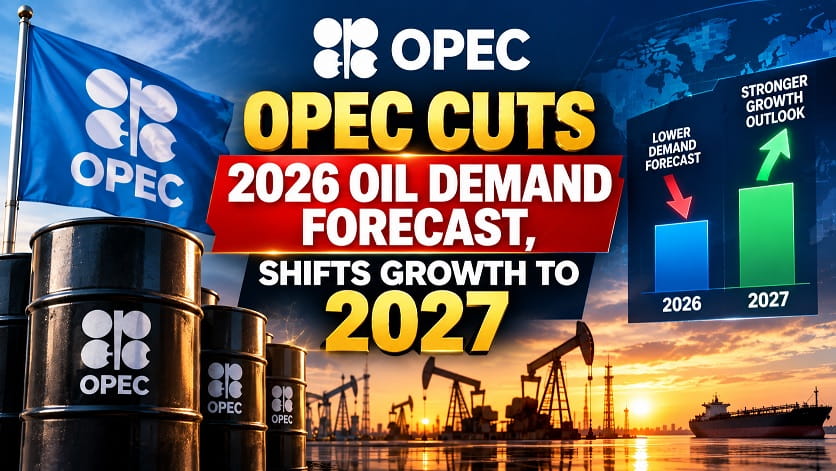
OPEC Cuts 2026 Oil Demand Forecast, Shifts Growth to 2027
The Organization of the Petroleum Exporting Countries (OPEC) has significantly reduced its forecast for global oil demand growth in 2026 to 400,000 barrels per day (bpd), down from an earlier projection of 1.4 million bpd at the start of the year. The revision, announced by OPEC Secretary General Haitham Al Ghais, reflects weaker-than-expected demand throughout 2026. At the same time, the group anticipates that deferred or pent-up demand will materialize in 2027, supporting stronger growth next year.
This adjustment highlights ongoing challenges in the global oil market, including the effects of high prices, geopolitical disruptions, and slower consumption patterns in key regions.
Details of the Revised Forecast
OPEC’s latest outlook marks a substantial downward revision of approximately 71% from its initial 2026 estimate. The organization noted that the change aligns with market developments observed over the course of the year. Despite the softer near-term picture, OPEC expects some of the demand that did not materialize in 2026 to appear in 2027 as conditions stabilize or improve.
Earlier reports from OPEC’s monthly assessments had already shown progressive cuts to the 2026 growth figure, with previous estimates moving lower through successive months before the latest confirmation.
Reasons Behind the Demand Growth Cut
Several factors have contributed to slower oil demand growth in 2026. Elevated oil prices have weighed on consumption in some markets. Geopolitical tensions and supply disruptions, particularly those linked to conflicts affecting key shipping routes and production areas, have also influenced global energy flows and economic activity. Weaker growth in major consuming regions, including slower-than-expected increases in China and India at certain points, further shaped the revised outlook.
OECD demand has faced particular pressure, with some forecasts pointing to contractions in advanced economies during the year.
Outlook for 2027: Expectations of Pent-Up Demand
OPEC has indicated that the demand deferred from 2026 is likely to support a rebound in 2027. Earlier assessments pointed to significantly higher growth rates next year, with some projections showing demand increases several times larger than the revised 2026 figure. This view assumes that some consumption delayed by high prices or economic uncertainty will return as conditions evolve.
The shift underscores OPEC’s assessment that the current softness is largely concentrated in 2026 rather than signaling a structural long-term decline in oil demand.
Implications for Oil Markets and Prices
A lower demand growth forecast for 2026 can ease pressure on the supply side and influence price dynamics, depending on how production levels are managed. OPEC and its allies (OPEC+) have been carefully adjusting output targets in response to market conditions. Reduced expected consumption growth may support arguments for continued production restraint or careful monitoring of inventory levels.
For oil-producing countries, the revision affects revenue expectations in the near term while raising hopes for a stronger recovery in the following year. Refiners, traders, and consuming nations will also adjust strategies based on the updated outlook.
Broader Context of OPEC’s Demand Assessments
OPEC regularly updates its demand forecasts in its Monthly Oil Market Report and through public statements by leadership. The organization has historically maintained a more optimistic view of long-term oil demand compared with some other agencies, emphasizing the continued role of oil in global energy systems alongside the energy transition.
The 2026 revisions form part of a series of adjustments made as real-time data on economic growth, industrial activity, transportation fuel use, and petrochemical demand became available.
Key Forecast Changes at a Glance
| Period | Earlier/Initial Forecast | Revised Outlook |
|---|---|---|
| 2026 Demand Growth | 1.4 million bpd | 400,000 bpd |
| Expected 2027 Dynamics | Stronger recovery | Pent-up/deferred demand |
| Overall Assessment | Optimistic start of year | Adjusted for weaker growth |
Regional Demand Trends
Emerging markets, particularly in Asia, remain central to future oil demand growth in OPEC’s longer-term view. While 2026 growth in countries such as China and India has been more muted than initially expected in some assessments, the organization continues to see these economies as key drivers once the current constraints ease. OECD regions are expected to show more limited or negative growth in the near term before potential stabilization.
Future Scope and Market Considerations
Looking ahead, the trajectory of oil demand will depend on economic recovery, energy prices, geopolitical stability, and the pace of efficiency gains and alternative energy adoption. OPEC’s expectation of stronger 2027 growth suggests confidence that current weakness is temporary. Market participants will closely watch subsequent monthly reports, production decisions by OPEC+, and indicators of industrial and transportation activity for confirmation of the anticipated rebound.
Frequently Asked Questions
By how much did OPEC cut its 2026 oil demand growth forecast?
The forecast was reduced to 400,000 barrels per day from 1.4 million bpd at the beginning of the year.
Why was the forecast lowered?
Weaker-than-expected demand growth throughout 2026, influenced by market developments including high prices and broader economic and geopolitical factors.
What does OPEC expect for 2027?
The organization anticipates that deferred or pent-up demand from 2026 will support stronger growth in 2027.
How does this affect oil prices?
Lower demand growth expectations can reduce upward pressure on prices, though actual outcomes also depend on supply decisions, inventories, and geopolitical events.
Is this the first revision of the 2026 forecast?
No. OPEC has adjusted its 2026 demand growth outlook multiple times during the year as conditions evolved.
What is the significance of the announcement?
It provides an updated assessment of near-term oil consumption trends and signals OPEC’s view that stronger demand may emerge in the following year.
Navigating a Shifting Oil Demand Landscape
OPEC’s decision to cut its 2026 oil demand growth forecast to 400,000 bpd while pointing to potential pent-up demand in 2027 reflects a recalibration based on real-world market developments. The revision highlights the challenges of forecasting in an environment marked by price volatility, geopolitical risks, and uneven economic performance. As the organization looks toward 2027 with greater optimism for demand recovery, oil markets will continue to balance supply management against evolving consumption patterns. Stakeholders across the energy sector will monitor subsequent data closely for signs that the anticipated rebound is taking shape.