

Google Signs 22-Year Nuclear Deal with Fortum in Finland: Powering AI Growth with Clean Energy
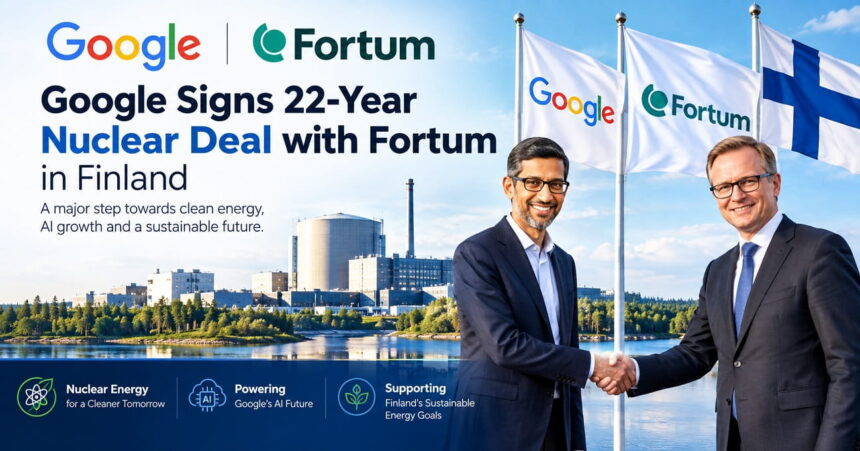
Google has signed a landmark 22-year power purchase agreement (PPA) with Finnish energy company Fortum for electricity from the Loviisa nuclear power plant. This marks Google’s first nuclear energy deal outside the United States and forms a key part of a broader €13 billion investment in AI and data center infrastructure in Finland over 2027–2028.
The agreement provides long-term revenue certainty for Fortum to extend the plant’s operations through 2050 while securing reliable, low-carbon power for Google’s expanding European digital footprint.
Key Details of the Nuclear Power Purchase Agreement
The PPA covers up to 50% of the Loviisa nuclear power plant’s capacity. It begins in 2028 with a smaller offtake volume and ramps up to the full contracted share from 2030 through 2049.
Loviisa consists of two VVER-440 pressurized water reactors that currently supply more than 10% of Finland’s electricity and employ around 580 people. Finnish authorities previously approved license extensions allowing operation until the end of 2050, but major investments were still required. Google’s long-term commitment unlocks the economic foundation for those upgrades.
In addition to supporting lifetime extension, the deal is expected to enable a further 10 MW capacity increase on top of an already planned 38 MW uprate scheduled for completion in 2028.
Google’s €13 Billion Investment in Finnish AI Infrastructure
Alongside the nuclear agreement, Google announced plans to invest at least €13 billion (approximately $15 billion) in data centers and supporting infrastructure across Finland in 2027 and 2028. Locations include existing and new developments in Hamina, Muhos, Vaala, and Kajaani.
This represents one of Google’s largest single investments in Europe and is projected to contribute around €3.6 billion to Finland’s GDP during the construction phase while supporting thousands of jobs once operational.
Why Nuclear Power Matters for Data Centers and AI
Modern AI training and inference workloads demand vast amounts of continuous, reliable electricity. Nuclear power offers baseload, low-carbon generation that complements intermittent renewables and helps stabilize prices and grid reliability. Finland’s cold climate further reduces cooling costs for data centers, making the country an attractive location for hyperscale operators.
Google has previously signed nuclear-related agreements in the United States. The Fortum deal extends this strategy into Europe and signals growing corporate interest in existing nuclear assets as well as potential new builds.
Broader Energy Partnership and Future Nuclear Exploration
Beyond the Loviisa PPA, Google and Fortum signed a memorandum of understanding to explore additional flexibility capacity and new power generation. This includes studying the commercial viability of potential new nuclear reactors at the Loviisa site. Fortum has already acquired land for possible expansion.
Google is also supporting 629 MW of new-to-the-grid onshore wind capacity in Finland and a 94 MW battery storage system near Kajaani, creating a diversified clean energy portfolio.
Historical Context of Loviisa and Finland’s Nuclear Sector
The Loviisa plant was Finland’s first nuclear facility. Unit 1 entered commercial operation in 1977 and Unit 2 in 1981. The reactors have undergone multiple upgrades and life-extension programs over the decades. Without the current investment program, operations would have been at risk of ending after 2030.
Finland has long relied on nuclear power as a cornerstone of its low-carbon electricity mix. The Google agreement reinforces the economic case for maintaining and modernizing existing assets while opening discussions about future capacity.
Impacts on Fortum, Finland, and the Energy Market
For Fortum, the PPA delivers predictable revenues that de-risk capital expenditure on life-extension work estimated in the range of €1 billion. Shares in the company rose sharply following the announcement.
For Finland, the combination of Google’s data center investments and the nuclear support strengthens energy security, supports jobs, and anchors the country as a hub for digital infrastructure in Europe. Keeping 10% of national electricity supply online avoids potential price pressure that could arise from plant retirement.
For the wider industry, the deal illustrates how large technology companies are increasingly willing to underwrite long-term nuclear output to meet sustainability and reliability goals.
Comparison of Key Elements in the Google-Fortum Partnership
| Element | Details |
|---|---|
| Duration | 22 years (2028–2049 focus) |
| Capacity Share | Up to 50% of Loviisa plant |
| Plant Contribution | ~10% of Finland’s electricity |
| Capacity Uprates | Planned 38 MW + additional 10 MW enabled |
| Google Investment | €13 billion in 2027–2028 |
| Additional Energy | 629 MW wind + 94 MW battery |
| Strategic Goal | Life extension to 2050 + potential new nuclear |
Future Scope and Industry Implications
The agreement is expected to accelerate corporate offtake of nuclear power across Europe. Other hyperscalers may pursue similar life-extension or new-build partnerships. For Finland, successful execution could lead to further data center growth and deeper collaboration on advanced nuclear technologies.
Challenges include timely delivery of plant upgrades, grid integration of new digital loads, and public acceptance of continued nuclear operations. The partnership also raises questions about the long-term role of private capital in supporting critical energy infrastructure.
Frequently Asked Questions
What is the length of the Google-Fortum nuclear deal?
It is a 22-year power purchase agreement covering the life-extension period of the Loviisa plant.
How much of the plant’s output is Google buying?
Up to 50% of capacity, starting smaller in 2028 and reaching the full contracted level from 2030 to 2049.
Why is this Google’s first nuclear deal outside the US significant?
It expands Google’s clean firm-power strategy into Europe and demonstrates willingness to support existing nuclear assets for decades.
How does this help Fortum?
It provides the long-term revenue certainty needed to complete investments that keep Loviisa operating until 2050 and enable capacity increases.
What else is Google investing in Finland?
€13 billion in data centers and infrastructure over two years, plus wind and battery projects.
Will there be new nuclear reactors?
Google and Fortum have agreed to explore the commercial viability of potential new reactors at the Loviisa site, though no final decision has been announced.
A Model for Clean Energy and Digital Growth
Google’s 22-year nuclear agreement with Fortum represents a practical convergence of AI infrastructure needs and nuclear energy reliability. By securing firm low-carbon power and enabling the continued operation of a major Finnish plant, the deal supports both Google’s growth plans and Finland’s energy and economic objectives. As data centers proliferate across Europe, similar long-term partnerships are likely to become increasingly common.