

Mahindra Unveils 26-Vehicle Roadmap, Vows ‘Attack Mode’ Growth: A Bold Vision for the Future of Indian Auto Industry
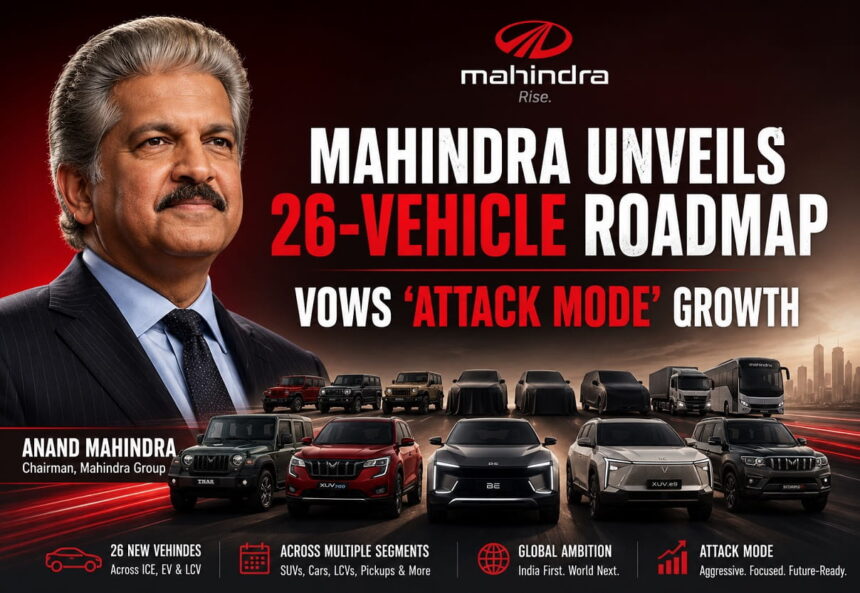
Mahindra & Mahindra has unveiled an ambitious 26-vehicle product roadmap extending to 2031, signaling aggressive expansion across SUVs, electric vehicles (EVs), and commercial segments. Backed by substantial investments and Chairman Anand Mahindra’s call for “attack mode” growth, the strategy aims to capitalize on disruption and drive multi-fold revenue increases in a competitive market.
This move positions Mahindra as a formidable player ready to accelerate amid global uncertainties, technological shifts, and evolving consumer demands in India’s dynamic automotive landscape.
Mahindra’s 26-Vehicle Roadmap: Key Details and Strategic Focus
The comprehensive roadmap outlines 26 new vehicle launches by 2031, with a strong emphasis on SUVs. Plans include 16 new SUVs — comprising 10 internal combustion engine (ICE) models and 6 electric variants — alongside expansions in light commercial vehicles and other segments.
This product offensive builds on successful platforms like the XUV and Scorpio series while introducing next-generation architectures such as the NU_IQ modular multi-energy platform. The strategy balances traditional powertrains with a growing EV portfolio to meet diverse customer needs and regulatory requirements.
Why ‘Attack Mode’ Growth? Anand Mahindra’s Vision Amid Uncertainty
Anand Mahindra has emphasized shifting from navigation to acceleration through an “attack mode” strategy, inspired by Formula E racing tactics. In an era where disruption is the new normal, Mahindra aims to seize opportunities rather than wait for clarity.
This approach integrates artificial intelligence across operations, accelerates investments, and pursues global leadership. The group is committing significant capital expenditure, including ₹9,112 crore in FY26, to fuel this aggressive push.
Investments and Manufacturing Expansion Powering the Roadmap
Mahindra is ramping up investments to support its ambitions. Key highlights include a massive new integrated manufacturing facility in Nagpur, Maharashtra, spanning 1,500 acres with a supplier park. Once fully operational, it will have capacity for over 5 lakh vehicles and 1 lakh tractors annually.
Additional plans feature technology upgrades, platform development, and ecosystem strengthening to ensure globally competitive products. These moves are expected to enhance efficiency, innovation, and scalability.
Historical Evolution of Mahindra’s Automotive Journey
Mahindra has grown from a tractor and utility vehicle pioneer to a multi-segment automotive leader. Iconic models like the Bolero, Scorpio, and Thar have built strong brand loyalty, particularly in rural and adventure segments.
Recent years saw successful forays into premium SUVs with the XUV700 and entry into EVs with models like the XEV 9e and BE 6. The new roadmap represents a natural evolution, scaling proven strengths while embracing electrification and modernization.
Impact on Indian Auto Industry and Economy
Mahindra’s aggressive plans are set to create significant ripple effects. Increased production and new launches will generate employment across manufacturing, supply chains, and related services.
The focus on EVs aligns with India’s sustainability goals, potentially accelerating adoption of cleaner mobility solutions. Enhanced competition in the SUV space could benefit consumers through better features, pricing, and innovation. Overall, it strengthens India’s position as a global automotive hub.
Future Scope and Opportunities in Mahindra’s Strategy
Looking ahead, Mahindra eyes nearly 8x growth in auto revenues from FY20 levels by FY30, with SUVs and new-energy vehicles as core drivers. Expansion into exports, advanced technologies like AI-driven features, and last-mile mobility solutions open additional avenues.
The roadmap positions the company to capture rising demand for versatile, tech-equipped vehicles while navigating challenges like raw material costs and policy shifts. Success hinges on execution, customer-centric innovation, and adaptability.
Regional and Segment-Wise Breakdown of Upcoming Launches
Mahindra’s portfolio expansion targets multiple categories:
- SUVs: New entries in compact, mid-size, and premium segments with both ICE and EV options.
- Commercial Vehicles: Strengthened offerings in light commercial vehicles for urban and rural logistics.
- Electric Mobility: Dedicated EV platforms delivering performance, range, and affordability.
This diversified approach mitigates risks and maximizes market coverage.
Challenges and How Mahindra Plans to Overcome Them
While the roadmap is ambitious, challenges include intense competition from established players and new entrants, supply chain volatility, and the pace of EV infrastructure development. Mahindra’s response involves heavy R&D investment, strategic partnerships, and a flexible multi-powertrain strategy to stay agile.
Mahindra Roadmap at a Glance
| Category | Planned Launches | Key Focus Areas |
|---|---|---|
| SUVs (ICE + EV) | 16 | New platforms, mid-cycle updates |
| Light Commercial Vehicles | Part of total 26 | Logistics and last-mile solutions |
| Electric Vehicles | 7+ | Dedicated architectures, performance |
| Overall by 2031 | 26 | Multi-energy flexibility |
Frequently Asked Questions (FAQs) about Mahindra’s 26-Vehicle Roadmap
What does the 26-vehicle roadmap include?
It encompasses a mix of new SUVs, commercial vehicles, and EVs, with launches phased through 2031, focusing on innovation and customer needs.
When will new Mahindra vehicles launch?
Several models are slated for 2026-2027, including updates to popular lines like Scorpio, Thar, and Bolero, alongside fresh EV offerings.
How does ‘attack mode’ strategy benefit customers?
It drives faster innovation, competitive pricing, advanced features, and wider choices in SUVs and electric mobility.
Will Mahindra focus more on electric vehicles?
Yes, with multiple EV launches and dedicated platforms, though ICE vehicles remain important for broader accessibility.
What is the expected impact on jobs and economy?
Significant positive effects through new manufacturing facilities, supplier ecosystem growth, and increased exports.
How does this compare to previous Mahindra plans?
This is far more detailed and ambitious, building on past successes with greater scale and technological integration.
Future Outlook: Mahindra’s Path to Leadership
With clear execution of the 26-vehicle roadmap and “attack mode” mindset, Mahindra is poised for transformative growth. The strategy not only targets domestic market dominance but also global competitiveness in a rapidly electrifying world.
Stakeholders across the industry will watch closely as the company translates these plans into on-road success, potentially reshaping India’s automotive future.