

Trump Announces Up to 200% Tariffs on Generic Drugs: Indian Pharma Stocks Slide Amid Trade Tensions
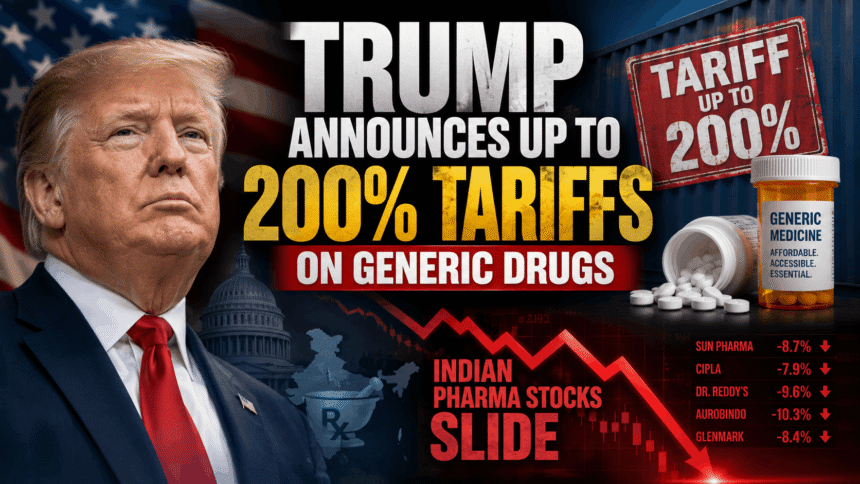
Former President and presidential candidate Donald Trump has announced plans for tariffs as high as 200% on imported generic drugs, targeting what he describes as unfair trade practices and aiming to boost domestic manufacturing. The announcement has sent shockwaves through global pharmaceutical markets, with Indian pharma stocks experiencing sharp declines as investors assess potential impacts on one of the world’s largest suppliers of affordable medicines.
This development highlights ongoing tensions in international trade, particularly in the critical healthcare sector, where generics play a vital role in global access to essential drugs.
Trump’s Proposed Tariffs on Generic Drugs
The proposed measures include tariffs reaching up to 200% on certain imported generic pharmaceuticals, with the explicit goal of encouraging reshoring of production to the United States. Trump emphasized protecting American jobs and reducing dependence on foreign supply chains, especially from countries like India and China.
The announcement specifies broad application across generic drug categories, potentially affecting a wide range of antibiotics, chronic disease medications, and other commonly used treatments. Implementation details would depend on future policy execution, but the signal alone has rattled markets.
Immediate Market Reaction: Indian Pharma Stocks Slide
Major Indian pharmaceutical companies saw significant stock price drops following the news. Firms heavily reliant on exports to the US market faced selling pressure as concerns mounted over reduced competitiveness and potential revenue losses.
The Indian pharma sector, known for its cost-effective generic production, contributes substantially to global supplies, including to the American healthcare system. This tariff threat exacerbates existing challenges like regulatory hurdles and pricing pressures.
Why Target Generic Drugs? Strategic and Economic Rationale
Proponents argue that heavy reliance on imported generics creates vulnerabilities in drug supply chains, as demonstrated during past global disruptions. Tariffs aim to incentivize investment in US-based manufacturing facilities, fostering self-reliance and job creation in the pharmaceutical industry.
Critics, however, warn of higher drug prices for American consumers and potential shortages if domestic capacity cannot quickly scale up to replace established import networks.
US Tariffs on Pharmaceuticals and Trade Policy
Trade tensions involving pharmaceuticals are not new. Previous administrations have used tariffs and trade remedies to address intellectual property concerns and manufacturing imbalances. India has long been a focal point due to its dominant position in generics, with past disputes over patents and market access.
This latest proposal fits into a broader pattern of using tariffs as leverage in negotiations over trade balances, national security, and economic sovereignty. Past implementations have led to mixed outcomes, including retaliatory measures from affected countries.
Potential Impacts on Indian Pharma Industry and Global Supply Chains
Indian companies export billions of dollars worth of generics to the US annually. A 200% tariff could severely dent profit margins, force price adjustments, or result in lost market share. Smaller players may struggle more than established giants with diversified operations.
Globally, higher costs could translate to increased prices for patients and insurers in the US, while other nations might benefit from redirected Indian exports. Supply chain diversification efforts could accelerate, benefiting alternative producers but raising short-term costs.
Future Scope and Possible Outcomes
If implemented, these tariffs could reshape the global generics landscape over the coming years. US manufacturers might ramp up production with government support, while Indian firms explore new markets in Europe, Africa, and Asia or invest in US facilities to bypass barriers.
Longer-term scenarios include trade negotiations leading to exemptions or phased rollouts, technological advancements in manufacturing reducing costs, or shifts toward more complex biologics where India is also expanding capabilities. The policy could also spur innovation in domestic US pharma.
Tariff Impact Comparison Table
| Scenario | Potential Effect on Indian Exports | US Drug Prices | Domestic Manufacturing |
|---|---|---|---|
| Full 200% Tariffs | Sharp decline | Significant rise | Strong incentive |
| Negotiated Reductions | Moderate impact | Mild increase | Gradual growth |
| No Implementation | Status quo | Stable | Limited change |
Broader Implications for Healthcare and Trade Relations
The announcement reignites debates on balancing free trade with national interests in critical sectors like healthcare. For patients, affordability of generics remains paramount, while policymakers weigh security against cost. India-US trade relations may face further strain, potentially affecting other sectors beyond pharma.
Frequently Asked Questions (FAQs)
What exactly did Trump announce regarding generic drugs?
Plans for tariffs up to 200% on imported generics to promote American production and address trade imbalances.
Why are Indian pharma stocks sliding?
Concerns over lost US market access and reduced profitability for major exporters.
Will these tariffs increase medicine prices in the US?
Likely yes in the short term, as higher costs could pass through to consumers and healthcare providers.
How big is India’s role in global generic drugs?
India supplies a significant portion of the world’s generics, including a large share of US imports, making it highly exposed.
Could this lead to drug shortages?
Possible if transitions to domestic supply are not smooth, though mitigation strategies are expected.
What might happen next in US-India pharma trade?
Negotiations, retaliatory measures, or adjustments by companies to minimize disruption.
Navigating Uncertainty in Global Pharma Markets
Trump’s tariff announcement on generic drugs underscores the intersection of politics, economics, and public health. While aimed at strengthening US manufacturing, the ripple effects on Indian pharma and worldwide drug affordability will be closely monitored. Stakeholders across the industry are preparing for various scenarios as policy details emerge and markets seek stability.