


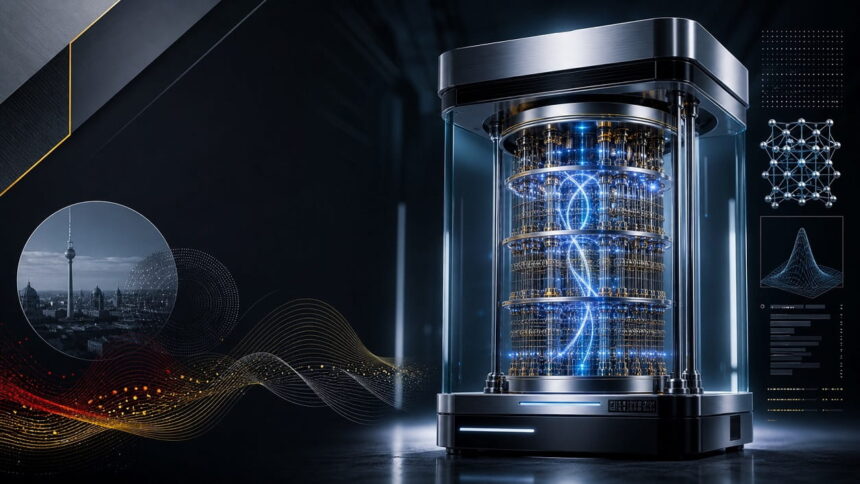
German Startup Launches Room-Temperature Quantum Computers: A Breakthrough in Accessible Quantum Technology
A German startup has made headlines with the launch of room-temperature quantum computers, marking a significant milestone in making quantum computing more practical and energy-efficient. SAXON Q unveiled its SXQ128 and SXQ512 models, which operate without the extreme cooling requirements of traditional systems, potentially democratizing access to quantum capabilities for research and industry applications.
This innovation could accelerate advancements in fields ranging from drug discovery to optimization problems, while addressing key barriers like cost and infrastructure that have limited quantum adoption so far.
What Are Room-Temperature Quantum Computers and How Do They Work?
Unlike conventional quantum computers that rely on superconducting qubits needing near-absolute zero temperatures, these new systems use synthetic diamond chips with nitrogen-vacancy (NV) centers. This approach allows stable qubit operations at room temperature, dramatically reducing energy consumption and simplifying deployment.
The SXQ128 features 128 physical qubits, while the more powerful SXQ512 offers 512 qubits. Both are rack-mounted systems designed for integration into existing data centers and research facilities.
Key Features of SAXON Q’s SXQ128 and SXQ512
High gate fidelity reaching up to 99.92% ensures reliable quantum operations. An advanced manufacturing process has boosted usable qubit yields above 85%, a major improvement over earlier attempts.
These machines excel in specific tasks such as quantum chemistry simulations, complex optimization, and materials science modeling. Their energy efficiency stands out, consuming far less power than cryogenically cooled alternatives.
Impact on the Quantum Computing Industry
The launch challenges the dominance of major players focused on superconducting or trapped-ion approaches. By eliminating cooling infrastructure, room-temperature systems lower entry barriers for universities, startups, and mid-sized companies.
This could speed up hybrid quantum-classical computing adoption, where quantum processors handle specialized workloads alongside traditional hardware. Global competition in quantum technology may intensify as other nations and firms pursue similar pathways.
Quantum Computing Development
Quantum computing has progressed from theoretical concepts to early prototypes over decades. Early systems required complex dilution refrigerators, limiting scalability. Nitrogen-vacancy centers in diamonds have long been studied for their stability at ambient conditions, but practical, high-qubit-count systems remained elusive until recent engineering breakthroughs.
German research institutions and the European quantum ecosystem have played pivotal roles in supporting such innovations, building on strong traditions in physics and materials science.
Future Scope and Potential Applications
Room-temperature quantum computers open doors to broader real-world use cases. Industries could apply them to logistics optimization, financial modeling, and secure communications. In healthcare, faster molecular simulations might accelerate new drug development.
Looking ahead, scaling qubit counts further while maintaining fidelity will be crucial. Integration with AI and classical computing could yield powerful hybrid solutions. The startup plans shipments of the smaller model soon, with the larger one following in 2027, providing a timeline for early adopters.
Challenges and Limitations to Consider
While promising, these systems are currently best suited for research and specific NISQ (Noisy Intermediate-Scale Quantum) era tasks rather than universal fault-tolerant computing. Error rates, though improved, still require sophisticated error correction. Competition from established technologies and the need for specialized software ecosystems remain hurdles.
Comparison of Quantum Computing Approaches
| Technology Type | Operating Temperature | Key Advantage | Main Challenge |
|---|---|---|---|
| Superconducting | Near Absolute Zero | High qubit counts | Extreme cooling costs |
| Room-Temperature (Diamond NV) | Ambient | Energy efficiency, ease of use | Scaling and error rates |
| Trapped Ion | Controlled | High fidelity | Slower operations |
Economic and Geopolitical Implications
Europe’s push in quantum technologies strengthens its technological sovereignty amid global rivalries. Successful commercialization could create high-value jobs, attract investment, and position Germany as a leader in next-generation computing.
For the broader economy, more accessible quantum tools may drive productivity gains across sectors, though equitable access and workforce training will be essential.
Frequently Asked Questions (FAQs) about Room-Temperature Quantum Computers
What makes room-temperature quantum computers different? They eliminate the need for expensive cryogenic cooling by using diamond-based qubits stable at normal temperatures.
Who is SAXON Q and what did they launch? A German startup that introduced the SXQ128 (128 qubits) and SXQ512 (512 qubits) systems on July 21, 2026.
Are these computers ready for commercial use? They are suitable for research and specialized applications now, with broader adoption expected as the technology matures.
How do they compare to big tech quantum systems? They offer advantages in accessibility and efficiency but may lag in raw scale compared to some superconducting platforms currently.
What industries will benefit most? Chemistry, materials science, optimization-heavy sectors like logistics and finance, and AI research.
When will these systems be available? The SXQ128 is expected to ship soon, with the SXQ512 following in 2027.
The Road Ahead for Quantum Innovation
The launch of room-temperature quantum computers by this German startup represents a leap toward practical, scalable quantum technology. By overcoming one of the field’s biggest practical obstacles, it paves the way for wider experimentation and eventual integration into everyday computing workflows.
As the industry watches the performance of these early systems, the pace of quantum advancement may accelerate, bringing closer the era of transformative computational power.